Toyota Plug-In Hybrids: Is a PHEV Right for Your West Kootenay Drive?
Maybe you've been curious about going electric, but the thought of running out of charge halfway up the Paulson Summit keeps you up at night. Or maybe you love the idea of skipping the gas station on your daily commute to Trail or Nelson, but you're not ready to give up the freedom of a long road trip. If that sounds familiar, a Toyota plug-in hybrid might be exactly what you're looking for.
The team here at Castlegar Toyota has seen our fair share of EV questions, so let's break down how plug-in hybrids work and whether one fits your life.
What Is a Plug-In Hybrid, and How Is It Different From a Regular Hybrid?
A plug-in hybrid (PHEV) has a larger battery that you charge by plugging in, so you can drive a meaningful distance on electricity alone before the gas engine ever turns on. A regular hybrid has a much smaller battery that recharges itself as you drive and can't be plugged in.
Think of a PHEV as an electric vehicle for your everyday driving and a hybrid for everything else. When the battery runs low, the gas engine takes over automatically, so there's no range anxiety.
So who is a plug-in hybrid best for? It shines if most of your daily driving is under about 80 km, you can charge at home, and you still take regular longer trips, whether that's a weekend in the Okanagan or a drive to the coast. It's also a smart choice if you'd rather not rely on public charging stations, which can be few and far between on rural highways.
Which Toyota Plug-In Hybrids Can You Get Right Now?
Toyota currently offers two plug-in hybrid models in Canada, and we have both on our lot.
The RAV4 Plug-in Hybrid is the star of the show. Redesigned for 2026, it pairs a 2.5-litre engine with two electric motors for 324 horsepower, comes standard with all-wheel drive, and can tow up to 3,500 lb when properly equipped. It's offered in several trims:
- SE: The efficiency pick, with the longest electric range of the lineup. It started at an MSRP of $48,750 at launch.
- XSE Technology Package: Adds more premium features and tech.
- GR Sport: Sporty styling and handling tuned with Toyota GAZOO Racing.
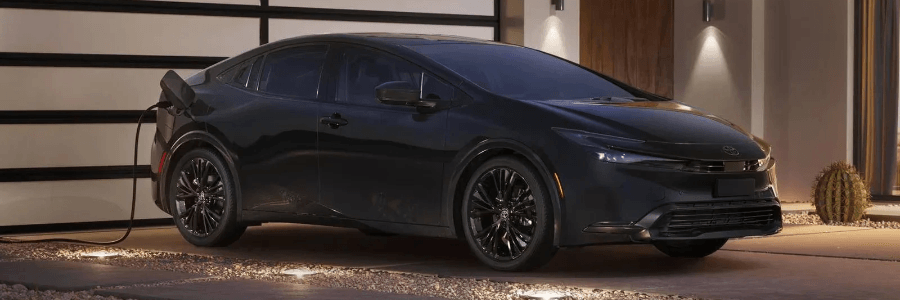
The 2027 Prius Plug-in Hybrid is the sleek, front-wheel-drive option for drivers who want maximum efficiency in a car rather than an SUV. Compare them on our RAV4 and Prius model pages, or browse our new Toyota inventory to see what's available today.
How Far Can a Toyota Plug-In Hybrid Go on Electric Power?
The 2026 RAV4 Plug-in Hybrid is rated by Natural Resources Canada for up to 89 km of electric range on the SE, about 85 km on the XSE, and 79 km on the GR Sport. That's enough for a round trip to Trail with room to spare, and close to a Nelson round trip in ideal conditions, often without burning any gas at all.
If you take anything from this article, make it this: electric range drops in cold weather. On a frosty January morning, expect noticeably less than the official rating, especially with the heater running. The good news is that the gas engine steps in seamlessly, so a trip over the Kootenay Pass is never a problem.
What about charging? You can plug into a standard household outlet overnight, but a Level 2 home charger is much faster and the most convenient choice for daily use. The RAV4 Plug-in Hybrid is available with an 11 kW onboard charger for quicker charging. Have more questions? Our Toyota electric vehicle FAQ covers charging, battery life, and more.
Are There Rebates for Plug-In Hybrids in BC?
Possibly. The federal Electric Vehicle Affordability Program, launched in February 2026, offers up to $2,500 on eligible new plug-in hybrids. There are price limits and other conditions, so not every model or trim qualifies. B.C.'s own provincial passenger EV rebate is not currently available.
Because the rules can change, ask our team which vehicles qualify before you buy. It's also worth checking our current Toyota deals and incentives to see what else can bring your price down.
Test Drive a Toyota Plug-In Hybrid at Castlegar Toyota
A Toyota plug-in hybrid gives you the best of both worlds: quiet, electric driving for everyday errands and the confidence of a gas engine for longer trips through the mountains. The only way to really understand it is to feel it for yourself.
At Castlegar Toyota, we don't just sell new and used vehicles to drivers across Castlegar, Trail, Nelson, and the West Kootenay. We also help you figure out which electrified Toyota fits your driving, from charging at home to understanding your options. Book a plug-in hybrid test drive today!
